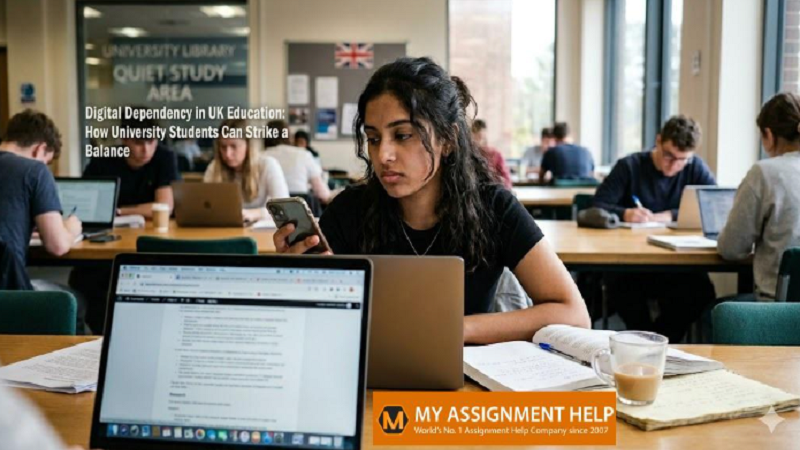
The landscape of British education has undergone a seismic shift over the last decade. Walking into a classroom at a sixth form in London or a lecture hall in Manchester today looks vastly different than it did twenty years ago. The rustle of paper and the scratching of fountain pens have been largely replaced by the soft hum of MacBooks and the tapping of styluses on iPads. Digital learning is no longer a “supplementary” tool; it is the backbone of the UK’s educational infrastructure. However, as the integration of EdTech (Educational Technology) reaches its zenith, a critical question arises for high school students, undergraduates, and educators alike: Are we becoming too dependent on technology?
The Digital Revolution in UK Schools and Universities
The UK government’s Education Technology (EdTech) Strategy has clearly accelerated the shift toward a digital-first learning environment. Today, tools like Google Classroom are no longer optional—they’re a routine part of how students submit assignments and interact with teachers. In universities, Virtual Learning Environments such as Moodle and Blackboard have become central hubs for lectures, resources, and assessments. For students, this transformation has brought undeniable advantages. Tasks that once meant hours in a library can now be completed in minutes online, complex subjects are easier to grasp through interactive simulations, and group work flows more smoothly thanks to cloud-based platforms.
At the same time, as courses grow more technical, students are increasingly relying on specialized online support. Those tackling demanding computer science subjects, for example, often turn to coding homework help to better connect theoretical concepts with real-world application.
Still, this heavy reliance on technology raises an important question. When digital tools shift from being helpful aids to absolute necessities, dependency becomes inevitable. It’s worth considering whether we’re truly developing capable, independent learners—or simply a generation that struggles to function without constant digital access.
3 Signs of Technology Dependence in Students
For many students, the line between “using” tech and “needing” tech has blurred. Recognizing the signs of digital dependency is the first step toward reclaiming academic independence:
- Cognitive Offloading: An immediate instinct to search for an answer online before attempting to recall information or solve a problem through logic.
- Digital Anxiety: Feeling unable to complete tasks or feeling “disconnected” from the learning process when a device or internet connection is unavailable.
- The Multi-Tab Effect: An inability to focus on a single piece of long-form text or a complex assignment without switching tabs to social media or unrelated content every few minutes.
The Shift from Critical Thinking to “Search Engine Thinking”
One of the primary concerns regarding technology dependence is the erosion of deep cognitive processing. In the past, if a student encountered a difficult problem in A-Level Mathematics or History, they had to grapple with the material, consult textbooks, and synthesize information manually. Today, the instinct is to “Google it.” While efficient, this “outsourcing” of memory and logic to search engines can lead to a phenomenon known as “cognitive offloading.”
When students know that information is readily available online, their brains are less likely to store that information long-term. This creates a “just-in-time” learning model where knowledge is accessed and immediately discarded. For those tackling complex coursework, this can be a double-edged sword. While consulting a professional assignment writer for students provides vital guidance for those overwhelmed by rigorous standards, the goal should always be to use technology to enhance understanding, not to bypass the learning process entirely.
The “Screen Time” Dilemma and Mental Well-being
In the UK, the Office for National Statistics (ONS) has frequently highlighted the correlation between high screen usage and mental health challenges among teenagers and young adults. Digital learning inevitably increases screen time, often blurring the lines between academic work and digital exhaustion. The “always-on” culture fostered by digital platforms means students often feel they can never truly leave the classroom. Notifications for upcoming deadlines or feedback on assignments pop up on the same devices used for socializing, leading to increased anxiety and burnout.
Furthermore, the physical toll of digital dependency is often overlooked. “Tech neck,” eye strain, and sedentary behavior are becoming chronic issues in the student population. The lack of a physical “end” to the school day—where work stays in a locker or a desk—means that for many, the bedroom has become a secondary office, disrupting sleep patterns and long-term wellness.
The Digital Divide: Is Technology Increasing Inequality?
While we discuss “dependence,” we must also acknowledge “access.” Dependence on technology creates a precarious situation for students from lower-socioeconomic backgrounds. If a curriculum is built entirely around digital fluency, those without high-speed fiber broadband or the latest hardware are left at a significant disadvantage. The UK’s digital divide became painfully apparent during the lockdowns, and despite various laptop schemes, the gap remains. When education becomes synonymous with technology, the “right to learn” becomes tethered to the “ability to pay” for the latest tech. This digital dependency doesn’t just impact individual learning; it threatens the egalitarian nature of the British education system.
The Impact on Essential Skills: Writing and Focus
There is also the physical aspect of learning to consider. With the rise of AI-powered writing assistants and sophisticated spell-checkers, are basic literacy and manual writing skills declining? Examiners at A-Level and GCSE still largely require handwritten responses. Students who have spent three years typing every note often find the physical stamina and cognitive focus required for a three-hour handwritten exam to be a significant hurdle.
Furthermore, the “multi-tab” lifestyle of modern students is the enemy of “Deep Work.” The constant temptation to switch from a research paper to social media reduces the ability to focus on complex tasks for extended periods. Academic resilience is built through sustained focus, a skill that is systematically eroded by the notification-heavy nature of modern learning devices.
The Role of AI: The New Frontier of Dependence and Agentic Literacy
We cannot discuss technology in 2026 without mentioning the evolution of Generative AI. Tools like ChatGPT and specialized academic agents have revolutionized how students approach essays and coding. The risk of dependency here is at its highest. If a student uses AI to generate an essay, they aren’t just using a tool; they are skipping the cognitive struggle that forms the basis of an education.
The UK’s Department for Education (DfE) has been proactive in exploring AI, but the consensus remains: AI should be a co-pilot, not the driver. This is where the concept of “Agentic Literacy” becomes vital. Agentic literacy is the ability to manage, direct, and critically evaluate AI agents rather than being led by them. It involves knowing how to prompt for research assistance while maintaining the final creative and analytical control. Students who master agentic literacy will find themselves at the forefront of the new economy, while those who succumb to AI dependency may find their critical thinking skills atrophied.
Striking the Balance: How to Use Tech Without Losing Yourself
Dependency isn’t inevitable. It is possible to harness the power of the digital age while maintaining academic independence. Here is how UK students can strike that balance:
- Analog Foundations: Start your brainstorming on paper. Use “mind mapping” with a pen to activate different neural pathways before moving to a digital document.
- Digital Literacy over Digital Dependency: Learn how to evaluate the credibility of sources rather than just clicking the first result on a search engine. This is particularly important for the 2026-2027 academic cycle as digital misinformation becomes more sophisticated.
- Scheduled Disconnection: Use “Focus” modes on your devices to block distracting apps during study hours. Ensure that your bedroom remains a tech-free zone at least an hour before sleep to combat academic burnout.
- Handwriting Stamina: Even if your school is paperless, take at least 20% of your notes by hand. This maintains the motor skills and cognitive links required for traditional exams.
- Seek Quality Assistance: When the digital noise becomes too much, turn to structured support. Myassignmenthelp.com can provide targeted, human-centric guidance needed to navigate difficult UK curriculum requirements, ensuring you understand the “why” behind the answer rather than just the “what.”
Frequently Asked Questions
Q.1 How does technology affect student concentration?
Research suggests that frequent multitasking on digital devices can decrease a student’s ability to engage in “Deep Work.” The constant presence of notifications and the ease of switching between academic and social tabs can lead to a fragmented attention span, making it harder to process complex information during long study sessions.
Q.2 Is AI allowed in UK A-Level and GCSE coursework?
The Joint Council for Qualifications (JCQ) has issued strict guidelines stating that students must submit work that is their own. While AI can be used as a research aid, using it to generate content that is passed off as original work is considered academic malpractice. Students are encouraged to develop “Agentic Literacy” to use these tools ethically as assistants rather than replacements.
Q.3 What is the “digital divide” in UK education?
The digital divide refers to the gap between students who have access to high-speed internet and modern devices and those who do not. In the UK, this often correlates with socioeconomic status. As education becomes more dependent on technology, students without these resources may face significant barriers to academic success.
Q.4 Can digital learning lead to academic burnout?
Yes. The “always-on” nature of digital platforms means students often feel they are never truly away from school. This lack of boundaries between home life and academic life, combined with excessive screen time, can contribute to increased stress, eye strain, and physical exhaustion.
Q.5 How can I reduce my dependence on search engines for learning?
Try the “recall first” method. When you have a question, give yourself 2-3 minutes to try and remember the answer or solve the problem manually before looking it up online. Additionally, using physical textbooks for core concepts can help embed information in your long-term memory more effectively than scrolling through web pages.
Conclusion: A Tool, Not a Crutch
Digital learning is an incredible asset to the UK’s education system. It has made information more democratic and allowed for innovative ways of learning that were unimaginable a generation ago. However, technology should be a tool that empowers the student, not a crutch that weakens them.
As we move forward, the goal for high school and university students should be “Digital Resilience”—the ability to use technology effectively when it’s available, but having the mental discipline and fundamental skills to succeed when the screen goes dark. The future of UK education is undoubtedly digital, but the most successful students will be those who remember how to think for themselves.
About the Author – Drake Miller
I am a dedicated blog author associated with Myassignmenthelp.com, known for creating insightful and student-focused content. He specializes in academic guidance, offering practical tips on assignments, time management, and study strategies. His writing aims to simplify complex topics and support students in achieving better academic outcomes with clarity, confidence, and effective learning techniques. Click here